10 Customer Retention Strategies for Restaurants in 2026
A busy restaurant can look healthy from the outside while losing its future. The dining room fills with first-time guests, the takeaway queue stays active, and social posts attract attention, yet only a small share of those diners comes back within the next month. Without a deliberate retention system, each service starts from zero.
The strongest customer retention strategies don't begin with another discount. They start by listening to guests, fixing the problems that make them leave, and training staff to deliver a dependable experience. Then they add relevant personalization, simple rewards, timely menu changes, and connected tools that work across every location and channel.
The sequence below follows that operating logic. Each tactic includes a practical workflow, a KPI worth tracking, and a place where TopFoodApp can support the work. The aim isn't to send more messages or collect more enrollments. It's to create more reasons for the right guests to return, while removing the friction that prevents them from doing so.
Table of Contents
- 1. Build a community through social engagement
- 2. Turn feedback into visible improvements
- 3. Resolve problems before guests disappear
- 4. Train staff to make reliability feel personal
- 5. Personalize the meal without creating safety risk
- 6. Use seasonal menus to create a reason to return
- 7. Send email that reflects guest behavior
- 8. Design loyalty around useful recognition
- 9. Make multiple locations feel dependable
- 10. Connect every channel without sacrificing reliability
- Top 10 Customer Retention Strategies Comparison
- Start With One Tactic and Measure What Changes
1. Build a community through social engagement
Friday dinner is full, the pass is busy, and your phone keeps lighting up with tags, story mentions, and comments about the dishes leaving the kitchen. If nobody on the team answers, that attention fades fast. If someone replies, reposts a guest photo, and points people to the right menu section in your TopFoodApp digital menu, social activity starts doing retention work.
The workflow needs to stay small enough to run every week. Pick a few repeatable content themes, assign one owner, and connect each post to a clear action. Ask guests to vote on a special, share the item they order every time, or react to a chef pick. Use location tags so nearby diners can find you, then answer comments like a host greeting regulars, not a brand filling a calendar.
Practical rule: Every social post should lead to a useful next step.
That next step can be a QR scan, a menu view, a reservation, or a reply that starts a conversation. Post strong dish photos, announce menu updates where guests already follow you, and use social-only prompts carefully. Constant discounts train people to wait. Recognition, curiosity, and relevance give them a reason to come back sooner.
Track the response: measure repeat visits from guests who engaged with social posts, QR scans tied to campaign links, comment response time, and visits linked to community content. Choose one response standard your team can maintain, assign ownership by shift or day, and review the numbers every month.
2. Turn feedback into visible improvements
Feedback has value only when someone acts on it. A review, comment, private message, or post-visit survey should enter a workflow that identifies the issue, assigns responsibility, and records what changed. Otherwise, asking guests for their opinions can make the restaurant look attentive while leaving the underlying experience untouched.
Place a private feedback form inside the TopFoodApp menu so diners can rate their visit and leave comments without publishing them immediately. A low rating can trigger an email alert, giving the manager a chance to contact the guest directly before frustration becomes a public review. Link feedback to the relevant menu item where possible. Complaints about a dish, missing allergen information, or unclear pricing are more useful when the team can locate the exact page and update it.
Review Google, Yelp, TripAdvisor, and social comments on a defined schedule. Then hold a short monthly review of recurring themes. If guests repeatedly mention slow ordering, confusing modifiers, or an unavailable item, assign one person to fix the process and another to confirm that the change reached the menu and floor team.
Useful KPIs include:
- Feedback response time: Record how quickly a manager acknowledges a complaint.
- Issue closure rate: Mark whether each actionable comment received a documented response.
- Repeat visits after feedback: Compare return behavior for guests whose concerns were resolved.
- Menu-specific complaints: Group comments by dish, section, location, or service occasion.
Tell customers what changed. “We clarified the allergen details” or “We adjusted the ordering flow” gives feedback a visible outcome and shows that the restaurant isn't collecting opinions for appearance.
3. Resolve problems before guests disappear
A service failure doesn't automatically end a customer relationship. An ignored service failure often does. Restaurants need a recovery process that starts during the visit, continues after departure, and feeds recurring problems back into operations.
Train front-line staff to escalate allergy concerns, incorrect orders, payment problems, and long waits immediately. The manager should have authority to choose an appropriate recovery action, such as replacing an item, removing an error from the bill, or inviting the guest to continue the conversation privately. Compensation shouldn't become an automatic coupon. It should match the problem and protect trust.
Monitor review platforms daily and respond to negative reviews with empathy and a specific next step. Avoid arguing about details in public. If the complaint identifies inaccurate menu information, update the TopFoodApp page quickly, then document why the error occurred. For allergy-related incidents, review both the digital allergen information and the staff handoff. The EU allergen guidance provides the regulatory context, while your operating procedure must make that information usable at the table.
Measure recovery, not just complaints
Track complaint volume, time to first response, time to resolution, repeat visits after recovery, and recurring root causes. A falling complaint count can mean improvement, but it can also mean guests have stopped reporting problems. Pair complaint data with return behavior and direct feedback.
Follow up personally after a serious issue. The purpose isn't to pressure the diner into a positive review. It's to confirm that the restaurant heard the problem, corrected the cause, and wants the next visit to be different.
4. Train staff to make reliability feel personal
Customers remember how a team handled uncertainty. A server who confidently explains an allergen filter, checks an ingredient with the kitchen, and offers a clear alternative creates more trust than a polished script delivered without care. Training should therefore connect hospitality standards to the exact tools and menu information staff use during service.
Use TopFoodApp's allergen management features in training rather than treating them as an administrative add-on. Staff should know how guests filter dishes, where ingredient details appear, and what to do when a request falls outside the published information. They also need to understand that a digital label doesn't replace a kitchen check when cross-contact or preparation changes the answer.
Role-play difficult moments:
- Dietary questions: Practice explaining what the menu confirms and what requires kitchen verification.
- Menu discrepancies: Rehearse how to acknowledge an incorrect price or unavailable dish without blaming the system.
- Service complaints: Let employees practise listening, apologizing, and escalating without becoming defensive.
- Accessibility needs: Test whether a guest can complete the menu journey and know where staff assistance begins.
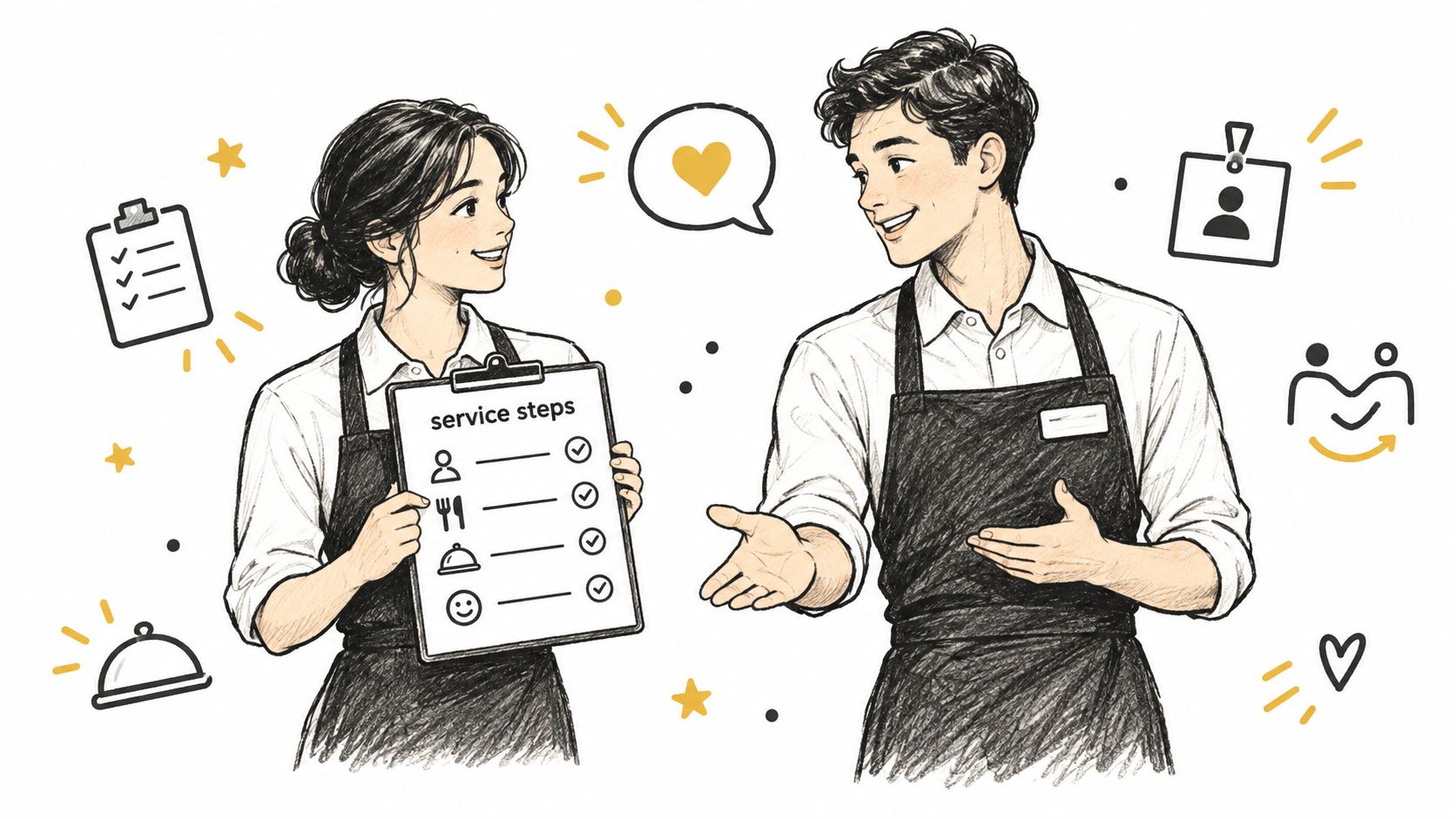
Give employees a defined recovery boundary so they can solve routine problems without waiting for a manager. Recognize specific behavior, such as a careful allergen handoff or a thoughtful follow-up, rather than praising vague “great service.”
The visual side of training matters too. Use the digital menu in live practice, not just screenshots in a handbook.
Use accessibility as a retention workflow
A 2025 survey of more than 600 blind and low-vision restaurant-goers found that 84% said accessibility influences whether they return, 92% said they would return to a restaurant offering an accessible customer experience, and 87% said it is critical that restaurants take their needs seriously (survey findings). Track menu abandonment, staff-assistance requests, accessibility complaints, and repeat visits after fixes.
A short training video can help managers introduce the expected service behaviors before role-play begins.
5. Personalize the meal without creating safety risk
Customization is powerful because it gives guests control, but it becomes dangerous when the restaurant treats every request as a marketing preference. A diner choosing a sauce on the side is different from a guest managing an allergy. The menu, ordering flow, and staff response must make that distinction clear.
Start with accurate ingredients and prominent allergen filters. TopFoodApp supports the 13 EU-regulated allergens, allowing guests to filter menu items before ordering. Add several clearly explained variants for popular dishes, such as vegetarian, vegan, or dairy-free options where the kitchen can support them. A special-request field can handle preparation instructions, but it shouldn't replace a controlled list of safe choices or a staff confirmation.
For a new restaurant or a menu redesign, create a digital menu with photos for free and use the images to clarify portions, sides, and presentation. If drinks matter to your concept, transparent menu detail also makes it easier for guests to compare restaurant wine prices without forcing staff to repeat basic information.
Connect customization to the right KPI
Track filtered menu views, item abandonment after allergen interaction, special requests, staff-assistance requests, and repeat visits among guests who used customization features. Don't infer satisfaction from filter usage alone. A guest may use a filter because the menu is clear, or because the available choices are poor.
Keep the data proportionate. Use consented first-party engagement and non-sensitive preference segments, such as interest in breakfast, cocktails, seasonal items, or a menu category. Avoid collecting personal information that the restaurant doesn't need to serve the guest.
6. Use seasonal menus to create a reason to return
A static menu gives guests convenience, but a changing menu gives them a reason to check back. Seasonal specials, chef-led dishes, cultural occasions, and limited availability can create anticipation without requiring a permanent discount.
Build each seasonal release as a small operating campaign. Decide the dish, pricing, allergens, service dates, stock assumptions, staff explanation, and promotion before publishing it. Use clear naming such as “Spring Specials” or “Weekend Chef Selection,” and remove expired dishes promptly. A limited-time offer loses credibility when guests keep seeing it after the kitchen has stopped serving it.
TopFoodApp's real-time QR menu update workflow lets the same QR code point to the current menu while the team changes sections, prices, visibility, and item details. That matters for restaurants that don't want to reprint menus every time a seasonal ingredient changes. It also reduces a common retention problem, where a guest returns expecting a dish that no longer exists and receives no explanation.
Promote the change through email, social media, table prompts, and staff recommendations. Link the campaign to the actual menu section, not to a generic homepage. If a new item has an allergen or preparation caveat, place that information where the guest makes the decision.
Measure the campaign: Track seasonal menu views, orders, repeat visits during the release, redemption of any associated offer, and which dishes guests revisit. Expand winners only when the kitchen can maintain quality and margin. Novelty that creates long waits or inconsistent preparation can damage retention instead of improving it.
7. Send email that reflects guest behavior
A guest orders gluten-free pizza twice, opens your seasonal menu email, then gets a generic discount for burgers. That message teaches them you are broadcasting, not paying attention.
Behavior-based email starts with consent and a clear trigger. Collect permission at checkout or through a deliberate TopFoodApp interaction. Then set up small segments your team can actually maintain: frequent guests, lapsed guests, guests who browse a seasonal section, guests who favor a menu category, and guests by language preference. The workflow matters here. Trigger the message from a real action, send people to the exact menu section they need, and keep the copy tied to one decision.
Personalization works when it is useful. McKinsey found that faster-growing companies get more revenue from personalization than their peers, but restaurants should treat that as a testing case, not a promise. Run the comparison in your own operation. Send one broad campaign, send one behavior-based campaign, and judge the result by repeat visits, margin, redemption, and unsubscribes. Open rate helps diagnose subject lines. It does not tell you whether the message improved retention.
Keep the offer or recommendation easy to act on. A pizzeria can send a seasonal topping launch to regular pizza buyers. A brewery can recommend a pairing based on past orders. A hotel can send a room-service menu that fits the guest's stay context. For hands-on workflows, teams can review personalized outreach with Mail Merge for Gmail.
TopFoodApp fits after the click. Use it to route each segment to the right menu destination and match the menu language to the message. It supports translation into 50+ languages, with one target language on Free and the full set on Pro.
Measure the campaign: track repeat visits, order value, unsubscribe rate, redemption, and incremental revenue after communication and reward costs.
8. Design loyalty around useful recognition
A guest finishes dinner, scans the receipt, and sees they are one visit away from a free dessert they would actually order. That kind of recognition works because it is easy to understand and easy for staff to explain. Morning Consult found that 53% ranked a free item among the top three features of a restaurant rewards program among 4,416 U.S. adults (survey methodology and findings).
Start with one reward that fits your margins and your service style. A complimentary beverage, side, dessert, or upgrade usually lands better than a complicated points formula. Show the same progress marker in the QR menu, email, receipt, and server script. If guests have to ask how close they are, the program is already creating friction.
The workflow matters. First, define the earning rule. Next, decide where progress appears. Then train staff on one short explanation and one recovery step when a reward fails to apply. Loyalty economics also depend on staff retention, because familiar servers and cashiers make recognition feel credible. Keeping that loop stable is part of building a thriving workplace.
For TopFoodApp, the practical KPI is monthly active returning guests. Break it down by venue type, visit frequency, menu category, and location so you can see whether the program changes behavior or only collects sign-ups.
Test the economics before adding tiers
Run a direct comparison. Offer a free-item reward to one group and an equivalent percentage discount to another. Measure second-visit rate, retention over your follow-up window, average order value, redemption rate, and margin per enrolled customer. Include reward cost and communication cost before you call the result profitable.
Recognition does not have to mean discounting. Early access to a seasonal menu, a named VIP section, a tasting invitation, or simple staff acknowledgment can reinforce the habit of returning without teaching guests to wait for a deal.
9. Make multiple locations feel dependable
A guest who visits your second location shouldn't have to relearn the menu, loyalty rules, or ordering process. Consistency creates confidence, especially for hotel groups, franchises, and restaurant brands that rely on guests moving between neighborhoods or cities. Local character still matters, but variation should be deliberate rather than caused by outdated files.
Create a master menu structure with standard sections, naming conventions, allergen fields, pricing formats, and photography rules. Use TopFoodApp's centralized menu management to maintain shared content while allowing location-specific dishes, opening hours, service periods, or local pricing where necessary. A universal QR code can direct guests to breakfast, lunch, cocktails, room service, or another venue menu without forcing the operator to create a separate workflow for every use case.
Version control matters. Record who changed a price, when a seasonal item became visible, and which locations received the update. If a dish is removed centrally, confirm that every site has the ingredients, staff briefing, and signage needed to support the change.
KPIs for multi-location retention include:
- Cross-location repeat rate: Count guests returning to another venue in the group.
- Menu accuracy incidents: Record incorrect prices, unavailable dishes, and missing allergen information by location.
- Shared loyalty activity: Track whether benefits and recognition work across venues.
- Service consistency: Compare feedback themes and recovery times across sites.
Don't force identical local menus when customer demand or supply differs. Set a controlled template, define what may vary, and audit the exceptions.
10. Connect every channel without sacrificing reliability
Omnichannel integration can sound complex, but guests experience it as a basic question: can I move from one interaction to the next without starting over? A diner may discover a dish on social media, scan a QR code at the table, ask a server about allergens, order through a website, and return to another location. Each handoff should preserve clarity.
Make the TopFoodApp QR code a dependable entry point. Link the website, social profiles, in-venue table cards, room-service materials, and ordering journey to current menu content. Keep pricing, promotions, availability, allergen information, and language options synchronized. If loyalty works across order methods, guests should understand how activity is recorded and where benefits appear.
Reliability deserves its own KPI. A 2025 U.S. survey of 457 adults found that 80% said technology influences where they choose to eat, while 76% had encountered payment-technology problems and fewer than one in four said payment technology always works (restaurant technology survey). Don't add another app or personalization layer until the current journey loads quickly, displays accurate information, and offers a staff-assisted fallback.
Build graceful recovery into the journey
Track broken QR scans, menu load failures, payment errors, abandoned sessions, support requests, and repeat visits after service recovery. Make the menu mobile-optimized, searchable, accessible by keyboard and screen reader where applicable, and available in relevant languages. For international service, use AI translation for restaurant menus, then have a person review important dish, allergen, and service details.
Technology should reduce dependency, not create a new reason to leave. A simple journey that works every time can protect trust better than a complex system that fails when a phone has no battery, connectivity drops, or a guest needs staff assistance.
Top 10 Customer Retention Strategies Comparison
| Strategy | Implementation Complexity 🔄 | Resource Requirements ⚡ | Expected Outcomes ⭐📊 | Ideal Use Cases 💡 | Key Advantages ⭐ |
|---|---|---|---|---|---|
| Community Building & Social Media Engagement | Medium, ongoing content cadence, moderation 🔄 | Low–Medium, content creators, community manager, social tools ⚡ | Higher engagement, UGC, improved brand loyalty and referrals 📊⭐ | Local restaurants, cafes, social-first campaigns, brand awareness drives 💡 | Authentic advocacy, cost-effective acquisition, social proof ⭐ |
| Feedback Collection & Continuous Improvement | Medium, survey workflows and response loop 🔄 | Medium, survey tools, analytics, staff time ⚡ | Actionable insights, reduced churn, better product-market fit 📊⭐ | Quality-focused venues, operators seeking iterative improvement 💡 | Identifies pain points, enables closed-loop improvements ⭐ |
| Proactive Issue Resolution & Service Recovery | Medium–High, protocols, escalation paths 🔄 | Medium–High, trained staff, compensation budget, tracking ⚡ | Converts detractors, reduces negative WOM, reputation protection 📊⭐ | High-contact hospitality, venues with service variability 💡 | Builds goodwill, salvages relationships, prevents negative reviews ⭐ |
| Exceptional Customer Service Training | High, program design, consistency, refreshers 🔄 | High, trainers, time, ongoing evaluation tools ⚡ | Higher satisfaction, fewer negative reviews, increased AOV 📊⭐ | Premium restaurants, chains seeking service differentiation 💡 | Defensible competitive edge, improved staff retention ⭐ |
| Personalized Dining Experiences & Customization | Medium–High, menu logic, operational changes 🔄 | Medium, menu tech, allergen filters, staff training ⚡ | Higher satisfaction, increased order value, broader market reach 📊⭐ | Full-service, dietary-focused, premium casual venues 💡 | Revenue lift via customization, safety for allergen customers ⭐ |
| Seasonal Menu Updates & Limited-Time Offerings | Medium, recipe testing and update cadence 🔄 | Medium, R&D, inventory planning, marketing ⚡ | Increased visit frequency, marketing buzz, inventory efficiency 📊⭐ | Concept restaurants, chains, social-media-driven promotions 💡 | Creates urgency/FOMO, keeps brand fresh ⭐ |
| Personalized Email Marketing | Medium, segmentation and automation setup 🔄 | Low–Medium, email platform, content, data integration ⚡ | High ROI, improved CLV and repeat visits (measurable) 📊⭐ | Businesses with customer data wanting repeat visits and offers 💡 | Cost-effective, measurable, highly targeted retention ⭐ |
| Loyalty Programs & VIP Recognition | High, tier design, tracking, fulfillment 🔄 | High, technology, rewards budget, program ops ⚡ | Increased visit frequency and lifetime value, predictable revenue 📊⭐ | Chains, high-frequency venues, brands seeking habitual customers 💡 | Drives repeat behavior, rich data for personalization ⭐ |
| Cross-Location & Multi-Venue Consistency | High, centralized governance and templates 🔄 | High, centralized systems, training, version control ⚡ | Consistent experience, easier scaling, network-wide insights 📊⭐ | Franchises, hotel groups, multi-site operators 💡 | Brand predictability, simplified loyalty and procurement ⭐ |
| Omnichannel Integration & Seamless Experience | Very High, systems integration and data mapping 🔄 | Very High, tech stack, security, ongoing maintenance ⚡ | Much higher retention, AOV, unified customer journeys (hard to replicate) 📊⭐ | Brands with web/app/in-store presence aiming for unified CX 💡 | Competitive advantage, unified data for personalization ⭐ |
Start With One Tactic and Measure What Changes
Customer retention strategies become useful when they change a daily decision. A restaurant doesn't need to launch all ten tactics at once. An independent café may start with feedback and service recovery, a food truck may prioritize community engagement and seasonal updates, while a multi-location group may need centralized menus and cross-location loyalty before adding more campaigns.
Choose the tactic that addresses your clearest retention risk. If guests complain about inaccurate dishes, fix the menu and measure menu-related feedback, abandonment, and repeat visits after the update. If staff resolve problems inconsistently, train them on one recovery workflow and measure response time, resolution, and return behavior. If customers return but don't engage with the menu, test one relevant seasonal recommendation instead of adding a broad promotion.
Set a baseline before changing the process. Useful measures include monthly active returning guests, repeat-visit rate, time between visits, offer redemption, average order value, margin per enrolled customer, menu abandonment, review response time, complaint closure, payment errors, and repeat visits after service recovery. Choose one primary KPI and a small number of supporting measures. Too many dashboards can hide the question you're trying to answer.
Run a 30-day test with a defined audience, one workflow, and one owner. Use TopFoodApp's QR menus and instant updates to make the customer-facing change without rebuilding printed materials or creating inconsistent versions across channels. Document the starting process, the change date, staff training, guest communication, and any operational issue that could affect the result.
Don't judge a loyalty effort by enrollment alone. Restaurant loyalty should be measured through active returning behavior, segmented by venue type, visit frequency, menu category, and location. A useful retention loop captures consented first-party engagement, identifies a preferred menu or service occasion, and delivers a relevant benefit or reminder before the expected next visit. The objective is a measurable increase in repeat behavior without teaching customers to wait for discounts.
At the end of the test, review both customer and operational evidence. Did guests return more often, or did staff handle more requests? Did a seasonal item create visits, or did it create stock and service problems? Did the feedback workflow reveal a menu issue that requires a permanent process change? Keep what works, revise what doesn't, and only then add the next tactic.
Retention is built through connected habits. Listen, repair, train, personalize, reward, update, and integrate. When each step has an owner and a KPI, repeat visits stop being a matter of luck and become an operating priority.
TopFoodApp provides free QR-based digital menus with unlimited menus, sections, dishes, and customer views, plus instant updates, allergen management, feedback collection, translations, and multi-location menu controls. Use TopFoodApp to connect a clearer menu experience with the customer retention workflow you want to test next.