Quality Assurance Process in Restaurants: The Complete Guide
A server brings a guest a dish that looks perfect, but the digital menu says it's nut-free even though the kitchen changed the sauce last week. At another table, a customer scans the QR code, finds yesterday's specials, and asks for an item that's no longer available. The first problem creates frustration. The second can create a serious food-safety risk.
These failures rarely happen because staff don't care. They happen because information changes faster than the restaurant's checks. A reliable quality assurance process connects purchasing, kitchen procedures, staff training, menu publishing, customer feedback, and corrective action. It prevents teams from relying on a final inspection after the damage is done.
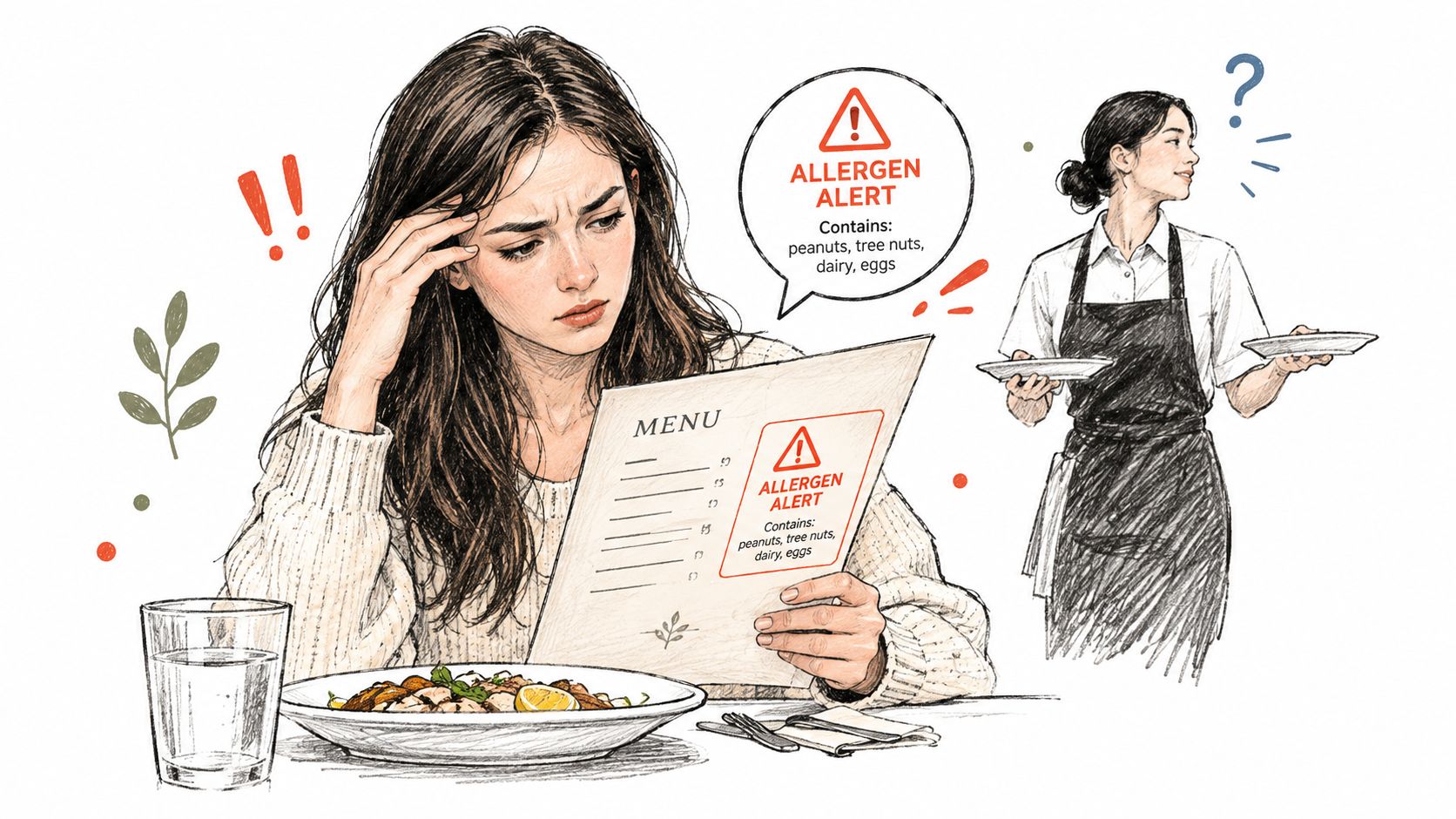
Quality assurance protects more than regulatory compliance. It protects guests who need dependable allergen information, employees who need clear instructions, and the reputation built through consistent service. A digital QR menu can support that work, but only when the restaurant verifies what it publishes, tests how guests access it, and keeps a fallback for people who can't or don't want to use a phone.
Table of Contents
- Introduction to Quality Assurance in Restaurants
- The Five Core Stages of a Quality Assurance Process
- Role Responsibilities and Key Performance Indicators
- Digital Menu Quality Assurance and Allergen Data
- Common Pitfalls and How to Avoid Them
- Practical Implementation Checklist and Templates
- Case Study - Multi-Location Restaurant QA Success
- Conclusion - Building a Sustainable QA Culture
Introduction to Quality Assurance in Restaurants
A restaurant's quality assurance process should answer a practical question: how do we prevent a known type of mistake from reaching the guest? The answer isn't another informal reminder at the pre-shift meeting. It's a repeatable system that defines standards, assigns ownership, checks results, and records what happens when something goes wrong.
Statistical process control established this preventive approach by shifting quality work from detecting defects after production to controlling variation during the process. Walter A. Shewhart's work at Bell Telephone Laboratories separated routine variation from unusual variation caused by identifiable factors, creating the foundation for control charts and modern process improvement (Oregon State University's overview of statistical process control).
That principle fits restaurant operations. A manager can monitor recurring order inaccuracies, missing allergen details, update failures, or inconsistent preparation steps, then investigate the cause instead of blaming the last person who touched the order.
Practical rule: If a check depends on someone remembering it at the right moment, it isn't yet a dependable process.
The strongest programs connect four actions: measure what matters, investigate the root cause, correct the process, and monitor the result. A printed allergen sheet, a digital menu, and a kitchen checklist only become QA when the team knows who verifies each one, when the verification happens, and what blocks service if the result is unsafe.
The Five Core Stages of a Quality Assurance Process
A useful restaurant QA cycle has five stages. They're sequential in practice, but the final stage feeds the next round of planning.
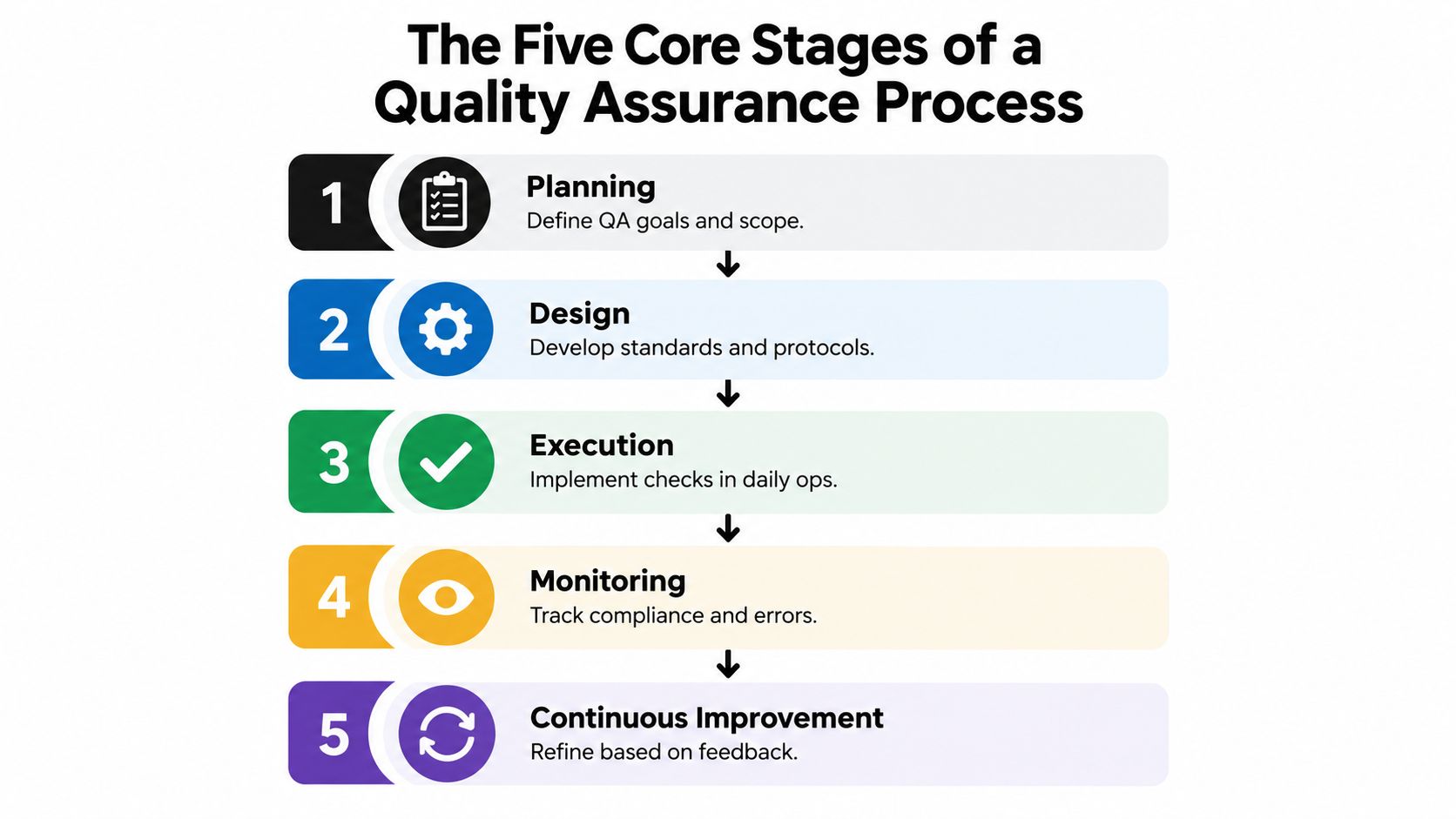
Planning
Start with the risks that matter most. Define which information must be correct before service, such as ingredients, allergen declarations, prices, availability, preparation notes, and opening hours. Include the channels customers use, from printed menus to QR pages and delivery listings.
Design
Turn those priorities into standards and workflows. Decide which employee owns supplier changes, who confirms recipe changes, who approves menu edits, and which records prove that approval happened. A good design also defines escalation. A suspected allergen error should never wait for a routine weekly review.
Execution
Build checks into ordinary work. The opening manager can verify the live menu and unavailable items, while the kitchen lead confirms that recipe changes match the ingredient and allergen record. Staff should know how to pause an item, report a discrepancy, and communicate safely with a guest.
Monitoring
Review evidence rather than assuming compliance. Track complaints, failed checks, update delays, repeated questions about allergens, and accessibility problems. Customer feedback is especially valuable because guests often find issues that internal teams miss.
Continuous improvement
Fix the system, not just the individual incident. If a menu stayed live after a recipe change, examine the approval path, permissions, training, and version control. The ISO 9000 family helped standardize documented processes, corrective action, customer requirements, and continual improvement across organizations. Reported ISO 9001 certificates rose from 409,421 in 2000 to 1,138,155 in 2014, an increase of approximately 178%, according to a historical review of ISO certification data (ISO quality-management history and adoption data).
For managers building a practical model, guidance on how relief chefs keep standards high is useful because temporary staff expose weaknesses in undocumented routines. If a capable relief chef can't follow the standard without verbal coaching, the standard probably isn't clear enough.
Role Responsibilities and Key Performance Indicators
Quality fails when ownership is shared vaguely. Assign one accountable person for every high-risk check, even though several employees contribute to the result.
The general manager owns the QA calendar, incident review, and training expectations. The kitchen manager owns recipe accuracy, ingredient substitutions, storage controls, and allergen confirmation. The front-of-house lead checks what guests see, including printed menus, QR pages, item availability, and staff responses to dietary questions. Every employee needs a clear route for reporting a discrepancy.
Useful operational indicators
Choose measures that lead to action rather than producing impressive-looking reports.
- Order accuracy: Record incorrect dishes, modifiers, and unavailable-item sales, then group them by cause.
- Allergen incidents: Log every suspected or confirmed information error, including near misses.
- Menu update timeliness: Compare the time a change is approved with the time it appears across customer-facing channels.
- Checklist completion: Review whether opening, closing, and changeover checks were completed properly, not just ticked.
- Complaint resolution: Record when a complaint is received, who owns it, and when the guest receives a response.
A manager's daily checklist can stay short: confirm the live menu, review sold-out items, verify urgent recipe changes, inspect the allergen reference, and ask the shift lead about unresolved incidents. Weekly, review patterns and retrain where the same failure appears.
Multi-location operators need standard definitions and local accountability. Practical guidance on how operators scale QSR brands reinforces the importance of repeatable operating standards, but a shared template still needs a named person at each site to complete and challenge it.
Digital Menu Quality Assurance and Allergen Data
A guest scans a QR menu, orders confidently, and then asks whether the sauce contains an allergen. If the digital listing disagrees with the approved recipe, the failure is operational and safety-related, not cosmetic.
Run digital checks alongside food-safety checks. Compare each published dish with its current recipe and ingredient record. Confirm regulated allergens explicitly, retain the previous version, and require approval for changes to ingredients, preparation methods, prices, or dietary claims. Test OCR and AI workflows with blurry photos, handwritten amendments, abbreviations, multilingual names, and crossed-out seasonal items.
AI can speed transcription and translation, but polished wording can hide an incorrect field. Validate every AI-extracted allergen against the source recipe, record uncertain characters or translations, retain version history, and require accountable human approval before publication. Research on AI-supported food quality control highlights the need for validation and traceability (Frontiers in Nutrition research on AI and food quality control).
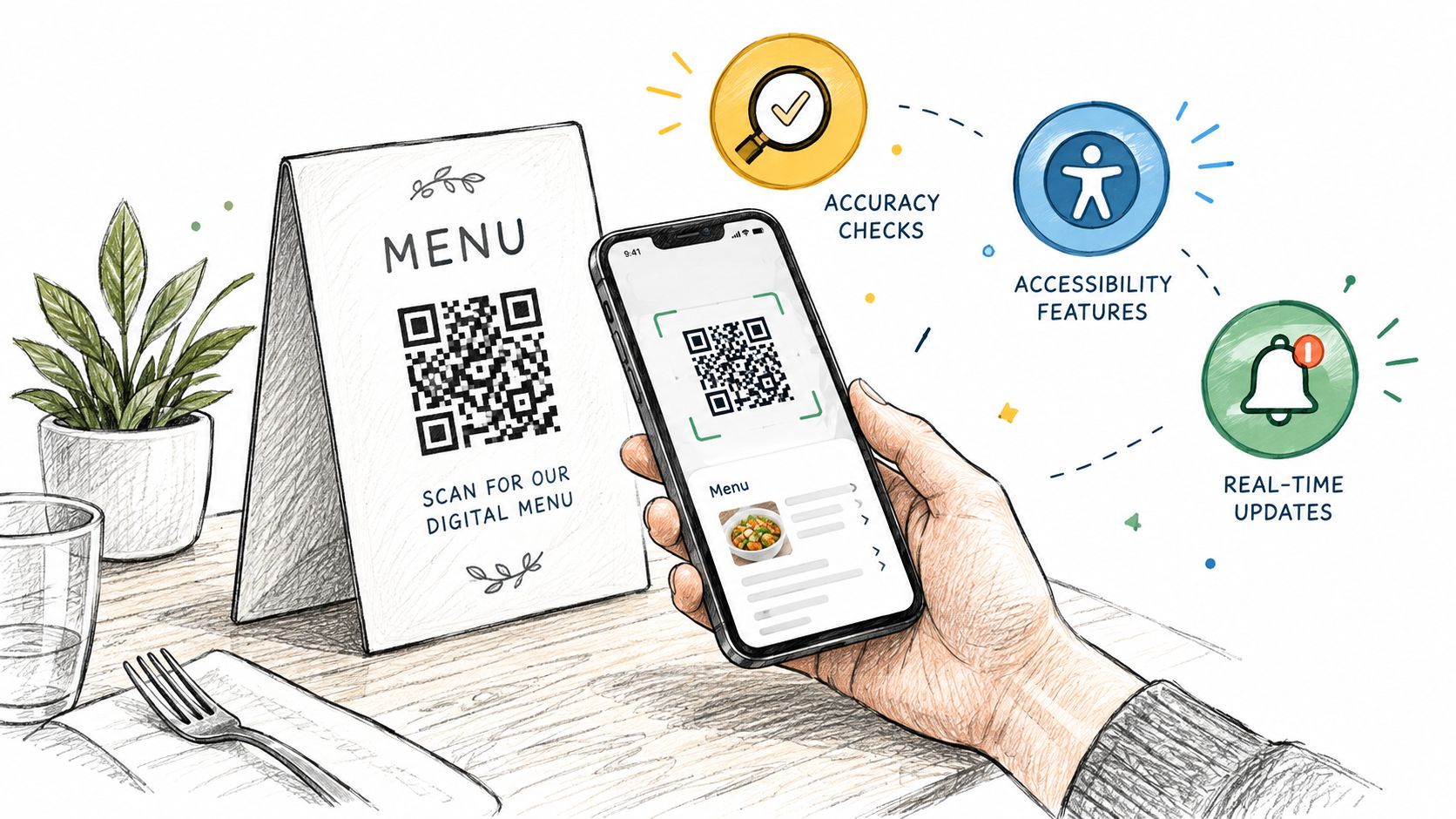
Test access, not just publication
A fast-loading page can still exclude guests. Test older phones, small screens, weak connectivity, zoom settings, screen readers, keyboard navigation, and large-text displays. Confirm that guests can find ingredients, allergens, prices, and alternatives without asking staff to interpret unclear labels.
Ipsos reported in July 2025 that 65% of U.S. adults had used a QR menu, while 58% wanted to return to paper menus and 39% hoped QR-menu use would continue (Ipsos research on QR-code menus). Usage does not guarantee satisfaction. Keep a clearly labeled paper option or staff-assisted route, and test that fallback during service.
Use this restaurant allergen compliance checklist with recipe and supplier records. The practical test is simple: can a guest who cannot use a smartphone obtain accurate allergen information safely?
Common Pitfalls and How to Avoid Them
The costly assumption is that QA consumes too much time. Restaurants usually lose more time correcting preventable failures, replacing incorrect dishes, answering avoidable complaints, and rebuilding trust after an allergen-information error.
Treating QA as a one-time inspection creates gaps. An accurate opening check cannot protect the menu after a supplier substitution, recipe change, or staff handover. Record the failure, identify its trigger, assign an owner, and add a control that prevents the same error during the next service.
Measure inclusion, not just availability
Uptime and scan volume show whether a digital menu can be reached. They do not show whether guests can use it. A practical inclusion test uses an older phone, weak connectivity, enlarged text, keyboard navigation, and a screen reader. Check whether a guest can locate ingredients, allergens, prices, and alternatives without staff interpreting vague labels.
Run the test during service, not only from an office network. Ask a staff member to complete it without insider knowledge, then record where the path breaks. Test the paper or staff-assisted route as well. A guest who cannot use a smartphone still needs accurate allergen information before ordering.
Use this restaurant allergen compliance checklist alongside recipe and supplier records. Compare the customer-facing allergen statement with the current dish, including substitutions and temporary preparation changes. If staff cannot answer consistently, pause the affected claim and escalate it to the person responsible for food safety.
Train staff on the update path, not only the published menu. They need to know how to report a change, who approves it, how to remove an item temporarily, and what to tell guests while verification is pending. Each shift should know where unresolved discrepancies are recorded and who closes them.
Practical Implementation Checklist and Templates
Start with a small operating rhythm that staff can complete consistently. A useful baseline includes an opening check, a change-approval check, an incident log, and a scheduled review of recurring failures.
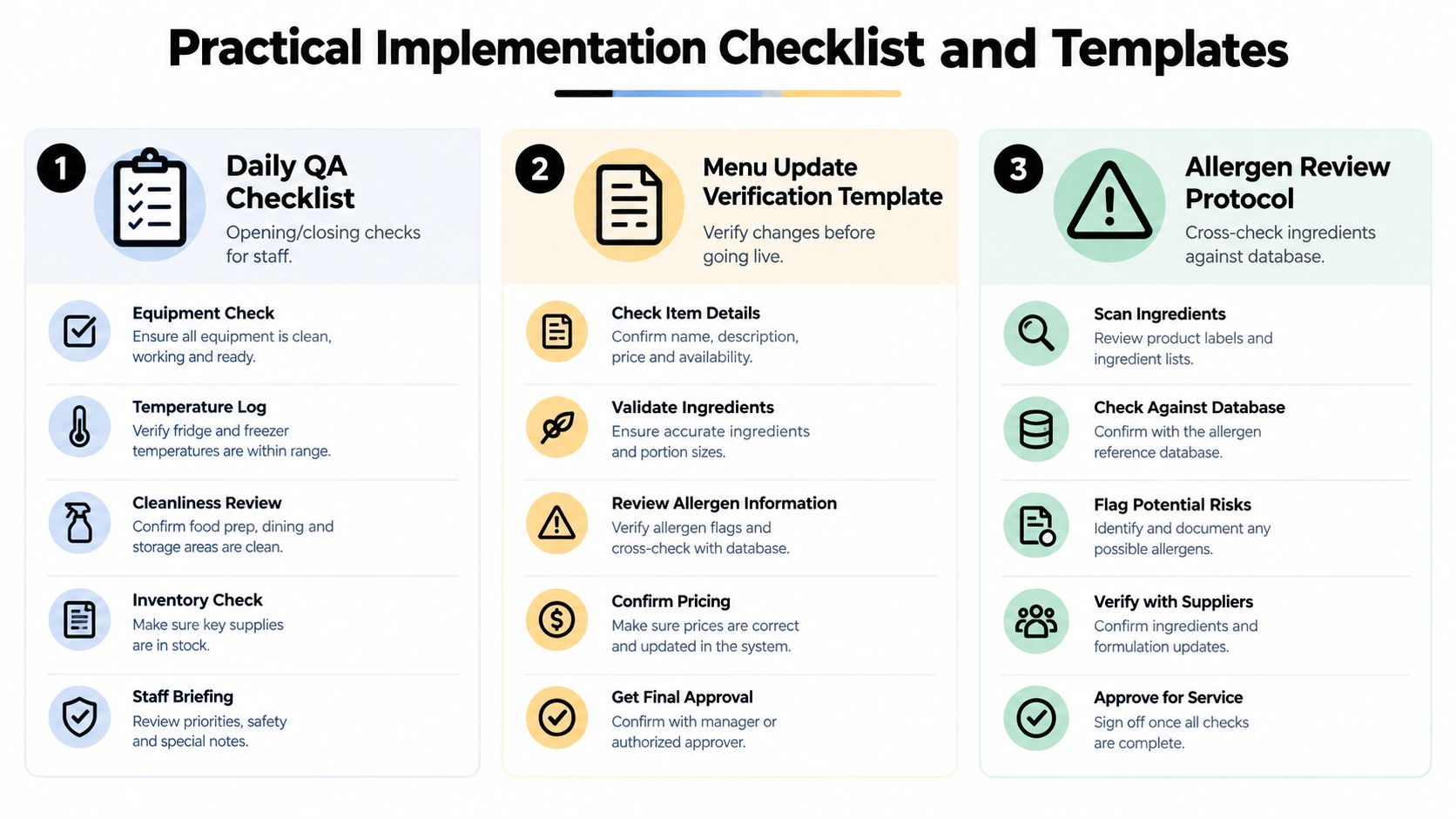
Daily QA checklist
At opening, the responsible lead verifies item availability, prices, service hours, QR links, and the allergen reference. During service, staff record substitutions and temporarily unavailable dishes. At close, the manager reviews unresolved discrepancies and assigns follow-up.
Menu update verification template
Use a simple record with these fields:
- Change requested: Name the dish, field, and reason for the change.
- Source confirmed: Identify the approved recipe, supplier notice, or manager instruction.
- Allergen review: Confirm each relevant allergen field explicitly.
- Customer view tested: Check the live page on a phone and through the fallback channel.
- Approval recorded: Add the approver, date, and release status.
- Rollback prepared: Keep the previous version available until the change is proven.
Paper and digital workflows compared
| QA need | Paper-led workflow | Digital-led workflow |
|---|---|---|
| Change distribution | Staff replace pages manually | Approved content can be updated centrally |
| Version control | Old copies may remain in circulation | Current and previous versions can be recorded |
| Allergen review | Markups require careful replacement | Structured allergen fields can support consistent checks |
| Accessibility | Large print requires separate production | Zoom, text size, and assistive technology need testing |
| Fallback access | Immediately available if maintained | Must be deliberately provided and labeled |
Digital tools reduce duplication, but they don't remove responsibility. A restaurant can use TopFoodApp's free menu creator to structure digital menus, manage menu content, and support allergen information, while keeping human approval for safety-critical changes.
For teams writing procedures from scratch, this practical SOP guide from AQEEK Coffee offers a useful model for turning informal routines into documented steps.
Case Study - Multi-Location Restaurant QA Success
A realistic multi-location QA project starts with standardization, not new software. Each site uses the same change request, allergen review, incident report, and opening checklist. Local managers still own execution, but the group shares definitions and escalation rules.
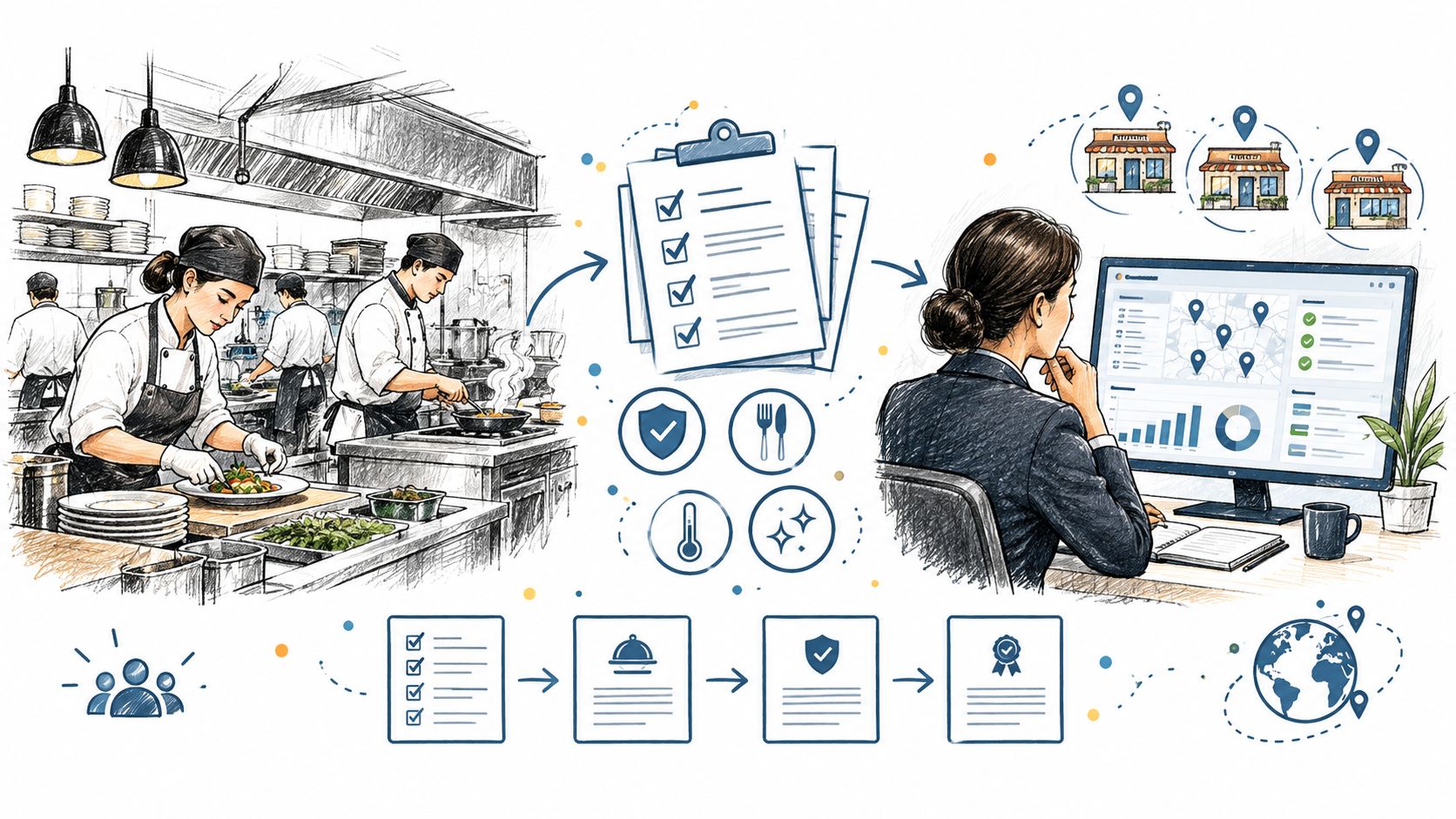
A practical rollout can follow this sequence:
- Map the sources: List recipe files, supplier information, printed menus, QR pages, and delivery listings.
- Assign owners: Give each location responsibility for local execution and give one central role responsibility for standards.
- Create one approval path: No ingredient or allergen change reaches customers without documented confirmation.
- Run controlled tests: Check real devices, printed alternatives, staff responses, and difficult menu inputs.
- Review incidents centrally: Group failures by root cause, then change the process that allowed them.
Managers should resist the temptation to compare locations before definitions are stable. One site may report every near miss while another records only customer complaints, making the data look better than it is. Calibrate what counts as an incident, a completed check, and a resolved complaint.
The result to pursue is not a dramatic headline metric. It's dependable behavior across sites: the same allergen question receives the same safe response, the same menu change follows the same approval route, and every location can show what happened when a check failed.
Conclusion - Building a Sustainable QA Culture
A sustainable quality assurance process is part of service delivery, not an extra project assigned to the manager during a quiet week. It begins with planning, turns standards into usable workflows, checks execution, monitors evidence, and improves the system when reality exposes a weakness.
Restaurants should start with the risks guests can't safely judge for themselves. Allergen information, ingredient changes, unavailable items, and accessible alternatives deserve stronger controls than cosmetic formatting. Digital menus need the same discipline as physical menus, with additional testing for devices, connectivity, assistive technology, version history, and fallback access.
Consistency matters more than complexity. A short checklist completed properly is more valuable than a long procedure nobody reads. A clear approval rule is more valuable than an attractive dashboard that doesn't identify who must act.
Train new staff on the reason behind each check, not just the button or box they must use. Review incidents without hiding them, distinguish random variation from a correctable cause, and change the workflow when the same error returns. That's how restaurants turn quality from an inspection event into a daily habit that earns customer trust.
TopFoodApp gives restaurants a way to create QR-based menus, update published content, and organize allergen information for customer-facing use. If you're ready to connect menu accuracy with a repeatable QA workflow, visit TopFoodApp and start building your menu process today.